Accept: text/markdown content negotiation explained
How RankReady answers the same canonical URL with HTML or Markdown depending on the Accept header, and why .md URLs never vary.
Last updated October 15, 2026
This page explains how one URL on your site can return two different formats depending on who asks, how RankReady implements that, and how to test each case with a single command.
What content negotiation is
Every HTTP request can carry an Accept header saying which formats the client can handle. A browser asks for HTML. A tool that wants plain text can ask for text/markdown instead. The server reads the header and picks a representation of the same resource.
The point is that the URL does not change. One canonical address, one piece of content, more than one way of expressing it. A link you share stays the link everyone uses, whether the thing following it wants a rendered page or plain text.
How RankReady handles it
There are two behaviours, and the distinction is the important part of this page.
The canonical URL negotiates, when you turn it on
On your normal post URL, with same-URL negotiation switched on, the Accept header decides the response:
| Request asks for | Response |
|---|---|
text/markdown |
Markdown |
text/html |
HTML, exactly as before |
| A type that cannot be served | 406 |
The 406 is a real answer, not a failure. It tells the client that the resource exists but not in the format it asked for, which is more useful than quietly returning HTML to something that said it could not read HTML.
Distinct .md URLs never negotiate
A .md URL such as /your-post-slug.md always serves Markdown, regardless of the Accept header. This is deliberate, and the reason is cache safety.
Shared caches, whether that is a plugin, your host’s page cache or a CDN, store a response against a URL. When one URL can return different bodies depending on a request header, every cache in the chain has to be configured to know that. Any layer that has not been told will serve whichever body it happened to store first, to everyone. That is how a plain text file ends up delivered to a browser, or a themed HTML page ends up delivered to a tool expecting Markdown.
Keeping .md URLs single purpose removes the question entirely. One address, one representation, safe to cache anywhere without special configuration. Negotiation stays on the canonical URL where it belongs, and the .md address remains the boring, reliable option.
Turn it on in RankReady
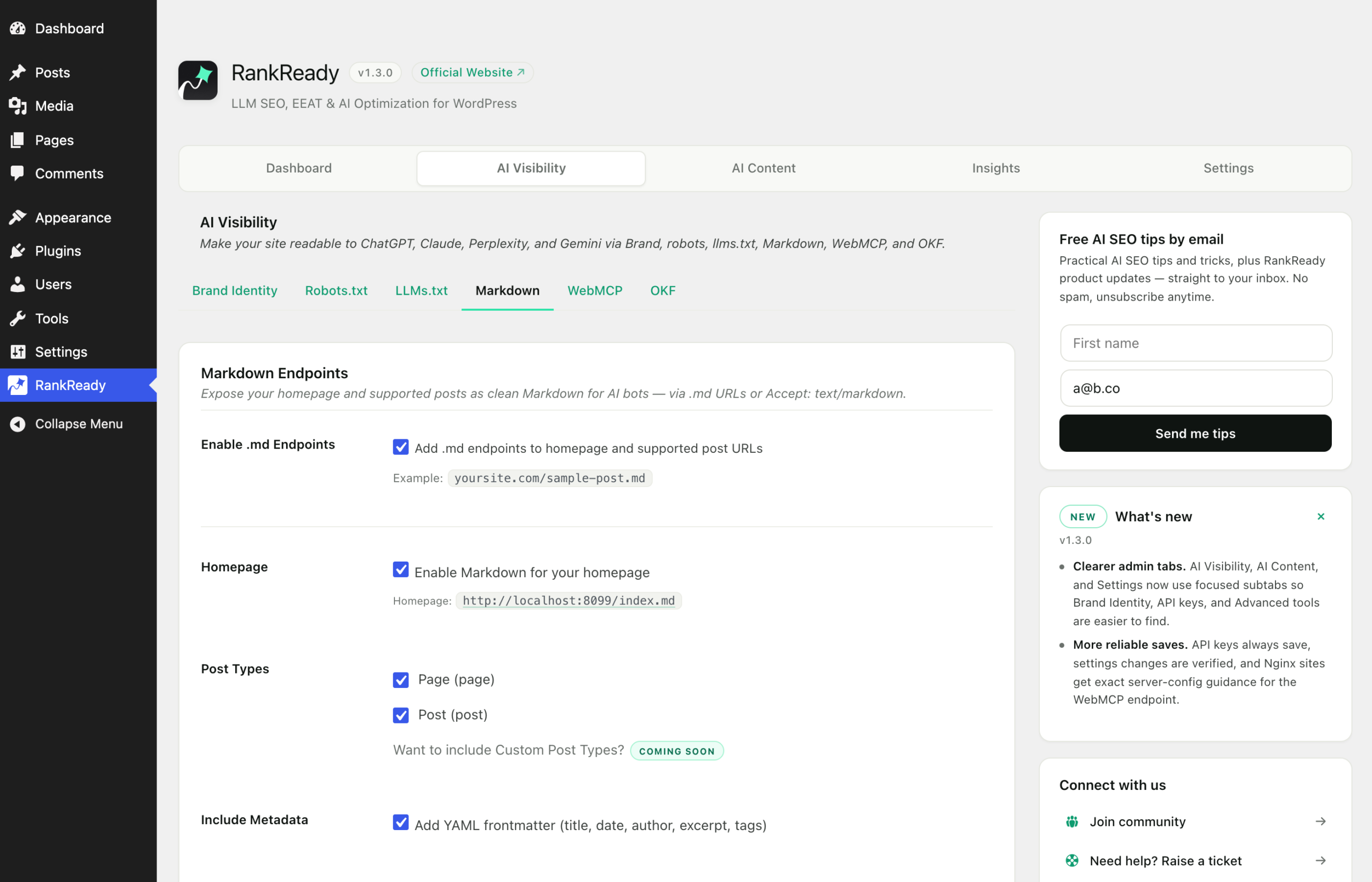
- In wp-admin, open RankReady.
- Go to the AI Visibility tab, ending in
tab=crawlers. - Open the Markdown subtab,
sub=markdown. - Switch the Markdown feature on. This gives you the
.mdaddresses. - Tick Same-URL content negotiation if you want the canonical URL to answer
Accept: text/markdownas well. - Save.
These are two settings. Negotiation is off for new installs and on for sites that upgraded from an older version. Leave it off behind Cloudflare, Varnish, Fastly or LiteSpeed caches, because a cache that ignores Vary: Accept can store the Markdown under your normal page address and show it to every visitor. The .md addresses work whatever this setting is. RankReady Diagnostics warns when it detects one of those cache layers. On Cloudflare APO, negotiation is switched off automatically and the .md addresses stay available.
Below it, Auto-serve to AI bots sends Markdown to known AI bots by User-Agent. It only applies while same-URL negotiation is on.
Responses on the canonical URL are sent as not cacheable, so a cache does not keep the Markdown under the page address. No AI provider key is involved.
Verify all three cases
These checks on the canonical URL need Same-URL content negotiation ticked. Use a real post URL. Pull one out of your /llms.txt if you are unsure, rather than typing a slug from memory.
Ask for Markdown on the canonical URL:
curl -s -H 'Accept: text/markdown' https://your-site.com/your-post-slug/ | head -20You should get Markdown. Headings appear as ##, and there is no theme markup.
Ask for HTML on the same URL:
curl -s -H 'Accept: text/html' https://your-site.com/your-post-slug/ | head -5You should get your normal page, starting with a doctype. Nothing about your site for human visitors changes.
Ask for something unsupported:
curl -s -o /dev/null -w '%{http_code}n' -H 'Accept: application/pdf' https://your-site.com/your-post-slug/You should see 406. If you see 200, negotiation is not reaching RankReady. Check the feature is on, then check what sits in front of the site.
Confirm the .md URL does not vary:
curl -s -H 'Accept: text/html' https://your-site.com/your-post-slug.md | head -5Markdown is the correct result here. The .md URL ignoring your Accept header is the design working as intended.
When negotiation does not appear to work
If the canonical URL returns HTML no matter what you ask for, something upstream is answering before WordPress does:
- Check that Same-URL content negotiation is ticked. It is off on new installs.
- Clear your page cache and try again. A cached HTML response will be replayed to every request regardless of headers.
- Test with the page cache plugin temporarily disabled to isolate it.
- If you sit behind a CDN, check whether it caches the canonical URL without accounting for the
Acceptheader. Many do by default. - Go to Settings, Permalinks and click Save Changes to rebuild rewrite rules.
Where a cache in front of your site cannot be made header aware, the .md URLs are the answer. They work through any cache because they never vary, which is precisely why they exist.
How much this reaches
Only some clients send Accept: text/markdown. Many do not, and support changes without announcement. Negotiation is worth having, but it should never be your only route. The distinct .md URLs and your /llms.txt index cover clients that never send the header at all, and none of these mechanisms guarantee that anything reads your content. They only guarantee it is available in a clean form.